
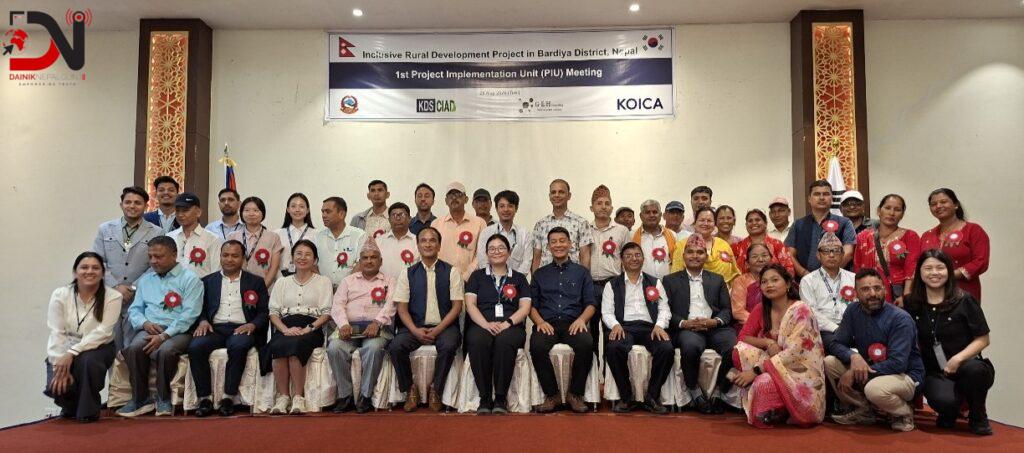
The Korea International Cooperation Agency (KOICA), in partnership with the Ministry of Land Management, Cooperatives, Federal Affairs and General Administration (MoLMCFAGA), held the first Project Implementation Unit (PIU) Meeting of the Inclusive Rural Development Project in Bardiya, Nepal (IRDB Project) on 26 May 2026.
With a total budget of USD 8 million, the IRDB Project aims to revitalize the local economy and promote inclusive rural development in Bardiya District. The project supports Locally Initiated Projects (LIPs) and strengthens cooperation among local governments, cooperatives, and relevant stakeholders.
The PIU Meeting was organized to review and refine business plans improved during the Korea Invitational Training Program (KITP), which was held in the Republic of Korea from 4 to 18 April 2026. The training brought together senior government officials, local leaders, and cooperative representatives to enhance their understanding of local economic development and business planning.
The meeting was chaired by Mr. Prahlad Kumar Karki, Under Secretary of MoLMCFAGA, and co-chaired by Ms. Yeo Sujin, Deputy Country Director of the KOICA Nepal Office. Participants included Chief Administrative Officers from the eight local governments of Bardiya, representatives from 20 cooperatives, and technical specialists from the Project Management Consultant (PMC), including the Korea Institute for Development Strategy (KDS) and GEH Consulting.
During the meeting, the PMC presented revised business plans for seven sectors: dairy, cash crops, agricultural mechanization, pig slaughterhouse development, compost production, fish processing, and ecotourism. The plans were improved based on consultations with Korean experts and lessons learned from KITP.
Following the presentations, PIU members provided technical feedback and recommendations to strengthen the feasibility, sustainability, and implementation readiness of the proposed initiatives. The PMC also presented a tentative timeline and endorsement plan for the business plans.
In her remarks, Ms. Yeo Sujin emphasized the importance of practical and implementation-oriented business plans developed through active collaboration among stakeholders. She noted that the project is owned by the local governments and communities of Bardiya and encouraged local governments to maintain strong ownership and institutional support for the project beyond the upcoming local elections.
Mr. Prahlad Kumar Karki highlighted the complementary roles of the PIU and the Project Steering Committee (PSC). He stated that the PIU serves as the project’s implementation body, while the PSC provides strategic direction and supports decision-making. He also called on the Chief Administrative Officers of the eight local governments of Bardiya to demonstrate strong ownership through active engagement, administrative support, and municipal co-financing.
Cooperative representatives who participated in KITP shared key lessons and practical experiences from the program and reaffirmed their commitment to implementing the enhanced business plans in cooperation with local governments and project stakeholders.
Prior to the meeting, the delegation paid a courtesy visit to Thakurbaba Municipality and conducted field visits to local cooperatives, including Jaleshwor Agriculture Multipurpose Cooperative and Thakurbaba Samajik Mahila Uddhami Cooperative. The visits provided an opportunity to assess the readiness, potential, and institutional commitment of the municipality and cooperatives for compost production and ecotourism initiatives under the project.